
Unsere abweichenden Öffnungszeiten an Ostern 2026
Am 3. April (Karfreitag) ist das Museum geschlossen, am 6. April (Ostermontag) geöffnet.
Wir freuen uns auf Ihren Besuch und wünschen schöne Feiertage!

 Im Archäologischen Museum Frankfurt sind über das Ende der Sonderausstellung „Mithras – Annäherungen an einen römischen Kult“ hinaus, die Funde aus den berühmten Mithräen von Nida (heute Frankfurt am Main-Heddernheim) zu sehen. Dies ist möglich dank Ausleihe der seit ihrer Auffindung 1826 zur Sammlung Nassauischer Altertümer gehörenden Steindenkmäler aus den Mithräen I und II von Nida durch die „Stiftung Stadtmuseum – sam“, mit der das Archäologische Museum Frankfurt eng zusammenarbeitet.
Mit vier oder fünf Mithräen gehört Nida zu den wichtigsten Fundstätten des Mithras-Kultes in den Nordwest-Provinzen des Römischen Reiches.
Sollten Sie also die Sonderausstellung nicht besucht haben, bietet sich weiterhin die Möglichkeit, sich über die neuesten Fo rschungsergebnisse zum Mithras-Kult und über die Bedeutung von Nida/Frankfurt für die Mithras-Forschung zu informieren und besonders eindrückliche Objekte wie das große, drehbare Kultbild aus Mithräum I zu bewundern. Dieses ist als Leihgabe der Stiftung Stadtmuseum Wiesbaden zum ersten Mal seit seiner Entdeckung im Januar 1826 in Frankfurt zu sehen.
Dank Augmented Reality können Besucherinnen und Besucher des Archäologischen Museums Frankfurt das berühmte, drehbare Kultbild des Mithras jetzt auch in einer farbigen Rekonstruktion erleben.
Über einen in der Dauerausstellung angebrachten QR-Code lässt sich mit dem eigenen Smartphone die kostenlose ZAUBAR-Anwendung starten. Sobald die Kamera auf das Kultbild aus dem Mithräum I von Nida gerichtet wird, erscheint es in seiner originalgetreuen Größe mit farbiger Bemalung auf dem Bildschirm – so, wie es in römischer Zeit ausgesehen haben könnte.
Das farbig texturierte Kultbild erscheint in seiner Originalgröße direkt als Überlagerung des realen Kultbildes. Über virtuelle Info-Punkte können Hintergrundinformationen als Text und Audio abgerufen werden; der im Original ursprünglich drehbare Mittelteil des Kultbildes lässt sich dabei sogar virtuell rotieren.
Vortrag
200 Jahre Mithras in Frankfurt
Dr. Wolfgang David, Leitender Direktor Mittwoch, 28. Januar 2026, 18:30 Uhr
5 € / 3 € + Eintritt
 Im Museum erhältlich:
Das Rätselheft zum Mithras-Kult!
Neben interessanten Informationen finden sich viele Rätsel, Bastelanleitungen, Spiele und Ausflugstipps in diesem Heft.
ISBN 978-3-88270-518-8
4,80 €
Vergriffen:
The Mystery of Mithras: Exploring the Heart of a Roman Cult
Hrsg. Laurent Bricault, Richard Veymiers und Nicolas Amoroso, in Zusammenarbeit mit Laure Barthet, Margaux Bekas, Pascal Capus, Alexandra Dardenay, Wolfgang David und Carsten Wenzel.
576 Seiten
Englische und französische Ausgabe
ISBN 978-2-8107-0750-8
35 €
Fotos: links AMF, W.David, rechts AMF, U. Dettmar.
 From 18 December 2024 to 31 August 2025, the Archaeological Museum Frankfurt will be showing the presentation ‘The Dark Side of Rome. The mass grave of Scupi’. The exhibition focuses on a remarkable archaeological find from a necropolis in the Roman city of Scupi, near modern-day Skopje in the Republic of North Macedonia: a mass grave that provides an insight into the darker side of the Roman Empire.
Archaeologists discovered a trench there in 2011 that contained the mortal remains of around 200 people. The arrangement and condition of the skeletal remains suggest that they are the victims of a mass execution, possibly deserters or failed political opponents from the political crises of the 3rd and early 4th centuries. The mass grave sheds light on the merciless, cruel reality of Roman military policy. In an era characterised by internal conflicts and power struggles, soldiers who were on the wrong side were often punished mercilessly.
The exhibition presents the results of interdisciplinary analyses of the skeletons, which provide clear indications of the cause of death of the buried. The research results of forensic anthropology, which also investigates mass graves from current conflicts of the 20th and 21st centuries, provide answers to a variety of questions: about the number of buried individuals, their gender and age, their external appearance, their illnesses and injuries before death, their occupation and their origin. Numerous original finds from the mass grave and sculptural portrait reconstructions are on display.
The exhibition was realised in close cooperation with the Museum of the City of Skopje.
Image: View of the mass grave (Photo: Museum of the City of Skopje).
From 18 December 2024 in the permanent exhibition of the Archaeological Museum Frankfurt
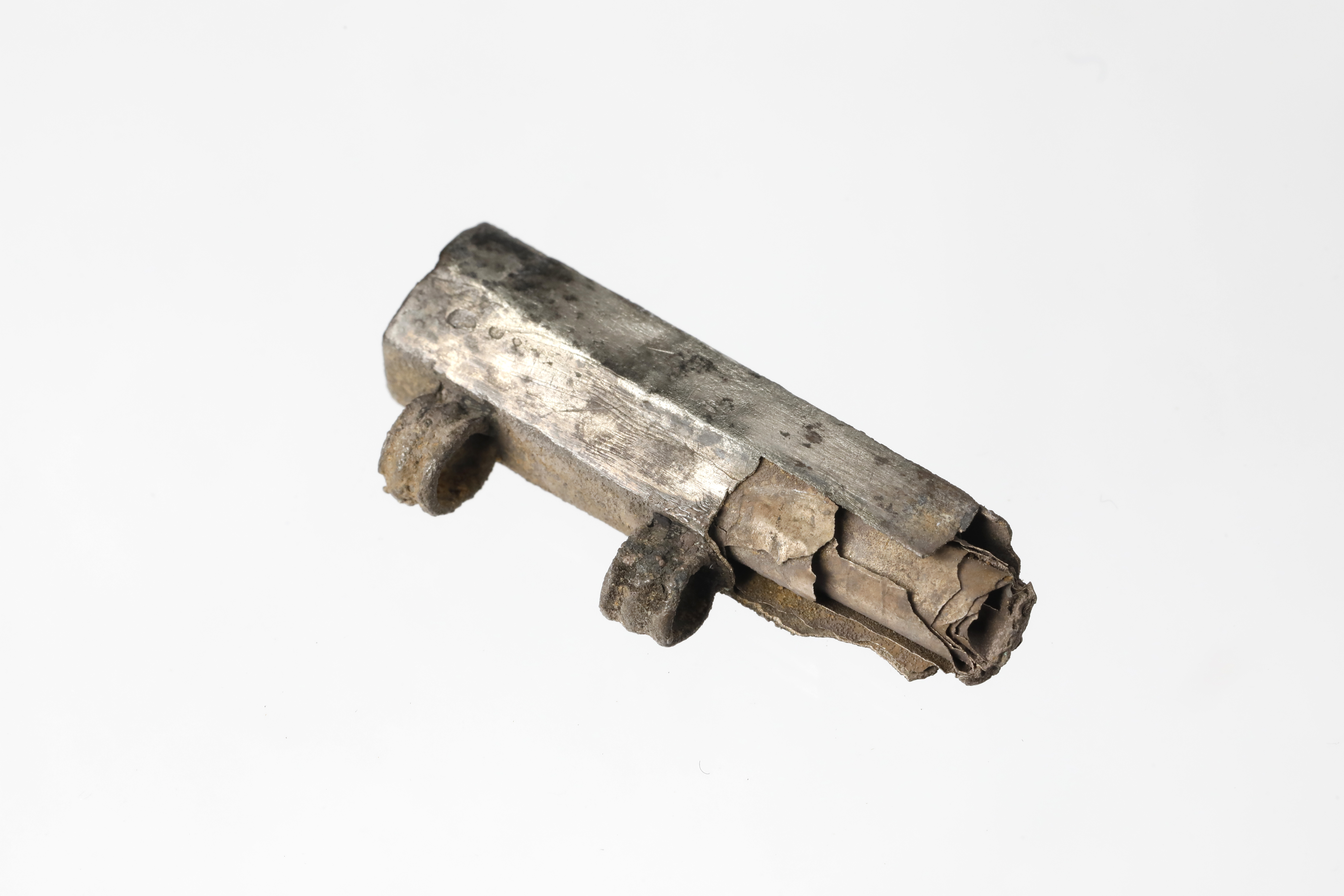
 A small silver amulet, just 3.5 cm in size, with a thin silver foil with a mysterious incision rolled into it: the ‘Frankfurt Silver Inscription’. Experts agree that these 18 lines will greatly enrich existing research into the spread of Christianity and the late period of Roman rule on the right bank of the Rhine. The inscription was deciphered thanks to state-of-the-art computer tomography technology. It shows that the text can be interpreted entirely in Christian terms, which is absolutely extraordinary for this period.
What is special is the age of the find. The tomb in which the amulet was found is dated to between 230 and 260 AD. There has never been such early, authentic evidence of pure Christianity north of the Alps. All finds are at least around 50 years younger. There are historical references to the first Christian groups in Gaul and perhaps also in the province of Upper Germania in the late 2nd century. However, reliable evidence of Christian life in the northern Alpine regions of the Roman Empire generally only dates back to the 4th century AD.
The ‘Heilmannstraße’ cemetery (Frankfurt am Main-Praunheim) and the Frankfurt silver inscription
The area of the Roman city of Nida (Frankfurt am Main-Heddernheim) is one of the largest and most important archaeological sites in Hesse. From a military junction in the 70s of the 1st century AD, the settlement developed into an economic and cultural centre after the withdrawal of the army in the early 2nd century AD. Nida became the capital of the northern Main border region, the civitas Taunensium. The city was one of the most important Roman settlements in Roman Germania and was characterised by its extraordinary cultural diversity. There are many indications that Nida experienced a period of prosperity until the 2nd quarter of the 3rd century AD.
The evaluation of the excavations carried out by the Frankfurt Monuments Office in 2017-2018 in the cemetery belonging to the Roman city on ‘Heilmannstraße’ (Frankfurt am Main-Praunheim) has now permanently changed our image of the late period of Roman rule in the areas on the right bank of the Rhine. During the excavations, a total of 127 graves were uncovered in a densely occupied area of around 500 square metres.
 According to current knowledge, the ‘Heilmannstraße’ cemetery has some special features: The location of the burial ground in the north-west corner of the ancient city boundary is unusual, as it was not connected to any of the important arterial roads.
The burials are clearly dominated by inhumations (113), 45 of which were without grave goods. In all other known cemeteries in Nida, the proportion of inhumations is only around 10%.
The cemetery also stands out from the other cemeteries in Nida due to a number of unusual grave goods (ensembles). This is emphasised, for example, by the diverse glass finds, which are missing in the burials known to date. What is also new for graves in Nida is the diverse evidence of jewellery, especially beads made of glass, gagat (fossil wood) and stone (including rock crystal). Remarkable is the evidence of 14 pairs of shoes that were placed next to the feet or on the lower legs of the deceased. They seem to indicate that the journey through life had come to an end and the footwear had thus become useless. The graves in Heilmannstrasse are thus similar to contemporary, high-quality burials in the Roman metropolises on the Rhine.
The most outstanding individual find is the silver amulet capsule from the body grave of a 35-45 year old man (site 134). The deceased was apparently still wearing the amulet around his neck in the grave. The capsule contained a rolled-up silver foil with an inscription carved into it. This was digitally unrolled in 2024 at LEIZA (Leibniz Centre for Archaeology) in Mainz and read by Prof. Markus Scholz (Goethe University Frankfurt am Main).
Conservation, restoration and digital unrolling
At the Archaeological Museum in Frankfurt, the find underwent conservation and restoration work. It was already clear during the excavation that the silver amulet contained a thin silver foil with an inscription. Microscopic examinations and X-ray images in 2019 already showed this, but it would be some time before the text could be deciphered beyond doubt. The wafer-thin silver foil itself is too brittle and fragile to simply roll it up due to the long time it has been in the ground. It would fall apart if you tried to roll it up. The breakthrough finally came in May 2024 when it was examined using a state-of-the-art computer tomograph at the Leibniz Centre for Archaeology in Mainz (LEIZA). ‘The challenge in the analysis was that the silver sheet was rolled, but after around 1,800 years it was of course also creased and pressed. Using CT, we were able to scan it at a very high resolution and create a 3D model.
 Reading the inscription
Archaeologist and expert in Latin inscriptions Prof Dr Markus Scholz from Frankfurt's Goethe University set to work like a puzzle and finally deciphered the 18 lines of the ‘Frankfurt Silver Inscription’. ‘Sometimes it took me weeks, even months, to come up with the next idea. I called in experts from the history of theology, among others, and bit by bit we worked together to approach the text and finally decipher it.’ Individual marginal passages were lost due to the storage on the floor. The addition of the relevant text passages remains open to discussion.
What is unusual is that the inscription is entirely in Latin. ‘This is unusual for this period. Normally, such inscriptions on amulets were written in Greek or Hebrew,’ explains Scholz. The text is also very sophisticated. The author must have been an elaborate scribe.
It is unusual that there is no reference in the inscription to any other faith besides Christianity. Normally, up until the 5th century, a mixture of different faiths can always be expected in precious metal amulets of this type. Often elements from Judaism or pagan influences can still be found. However, neither Yahweh, the almighty God of Judaism, nor the archangels Raphael, Gabriel, Michael or Suriel are mentioned in this amulet, nor are the forefathers of Israel such as Isaac or Jacob. And no pagan elements such as demons either. The amulet is purely Christian.
The ‘Frankfurt Silver Inscription’ translated into German (as of 04.12.2024)
(In the name?) of St Titus.
Holy, holy, holy!
In the name of Jesus Christ, Son of God!
The Lord of the world
resists [to the best of his ability?]
all attacks(?)/setbacks(?).
The God(?) grants the well-being
entry.
This means of salvation(?) protects
the person who
surrenders to the will
of the Lord Jesus Christ, the Son of God,
since before Jesus Christ
all knees bow to Jesus Christ: the heavenly
the earthly and
the subterranean, and every tongue
confess (to Jesus Christ).
Significance for science
The evaluation of the significance of the find by experts for early Christianity and theologians is still in its infancy. Some of the formulations contained in the text were only attested many decades later. For example, at the beginning of the ‘Frankfurt Silver Inscription’ there is a reference to St Titus, a disciple and confidant of the Apostle Paul. Just like the invocation ‘Holy, holy, holy!’ (Trishagion), which was not actually known in the Christian liturgy until the 4th century AD. (Trishagion). At the end, the text also contains an almost literal quotation from Paul's so-called Christ hymn from his letter to the Philippians (here: Phil. 2, 10-11).
The ‘Frankfurt Silver Inscription’ is therefore one of the most important testimonies to early Christianity in the world. Its discovery opens up new horizons for archaeology, historical sciences and theology, but also a multitude of new questions.
Together with the analysis of the entire ‘Heilmannstraße’ cemetery, these results modify some of the ideas that have hitherto been common in research about the end of the Limes region on the right bank of the Rhine in the 2nd half of the 3rd century AD and emphasise the prominent position of NIDA within Roman Germania. The city of NIDA was an administrative, economic and religious centre in the hinterland of the Upper Germanic Limes and, until its abandonment around 270/275 AD, was a major centre of the Roman Empire.
An interview with Prof Dr Wolfram Kinzig from the University of Bonn can be found here.
Project participants
The project exemplifies the synergies of cooperation between different institutions and project partners.
City of Frankfurt am Main
Archaeological Museum Frankfurt (Department of Culture and Science)
Denkmalamt Frankfurt (Department of Planning and Housing)
Leibniz Institute for Archaeology in Mainz (LEIZA)
Johann Wolfgang Goethe University Frankfurt
University of Regensburg
Rheinische Friedrich-Wilhelms-University Bonn
Rhine-Main Archaeological Network (VARM)
Photos:
Fig. 1: U. Dettmar, AMF
Fig. 2: © Leibniz Institute for Archaeology in Mainz (LEIZA)
Fig. 3: © Monument Office of the City of Frankfurt am Main, photo: Michael Obst
Fig. 4: © Prof. Dr Markus Scholz


